If you’ve lived along the river between Cold Spring and Fishkill for more than a winter or two, you already know the wind here doesn’t behave like the wind ten miles east in flatter parts of Westchester. The Hudson narrows and the hills close in on both sides right around the Highlands, and that geography does something specific to airflow: it squeezes it. Meteorologists call it a terrain funnel effect. Homeowners call it “why did my neighbor’s shingles end up in my gutter.”
A roof rated for standard suburban wind exposure can still fail here, not because the shingle was defective, but because the site conditions were never what the rating assumed.
What the wind rating on a shingle bundle actually means
Every asphalt shingle sold today carries a wind rating, usually somewhere between 60 and 130 mph depending on the product line and how it’s installed. That number comes from a lab test on a flat, open test rig, not from a roof sitting on a ridge above a river gorge. New York’s building code sets a baseline design wind speed for the region, and most contractors build to that baseline and call it a day.
The problem is that a baseline number describes open, unobstructed terrain measured at a standard height. It says nothing about what happens when prevailing wind gets compressed between Bull Hill and Storm King, or when it accelerates coming off the water and hits a roof sitting higher on a slope than the houses around it. Homes in Garrison, Cold Spring, and the hillier parts of Philipstown routinely see gusts that outrun what a generic install plan accounts for, even when the shingle package itself is rated adequately.
Where wind actually tears a roof apart
Wind doesn’t peel a roof off all at once. It starts at an edge.
The rake edges (the sloped sides of the roof) and the eaves take the brunt of uplift because that’s where wind first gets underneath the shingle line. A starter strip that’s missing, cut too narrow, or installed with the sealant strip facing the wrong direction gives wind a place to grab. From there it works backward, tab by tab, until a whole section lifts.
The other failure point is the nailing pattern. Most residential roofs get a four-nail pattern because it’s faster and meets minimum code in low-wind zones. In a wind corridor, four nails per shingle isn’t enough margin. A six-nail pattern, with each nail driven into the reinforced nailing strip rather than high or low on the shingle, holds meaningfully better under repeated gusting, which is the real-world wind pattern here rather than one sustained blow.
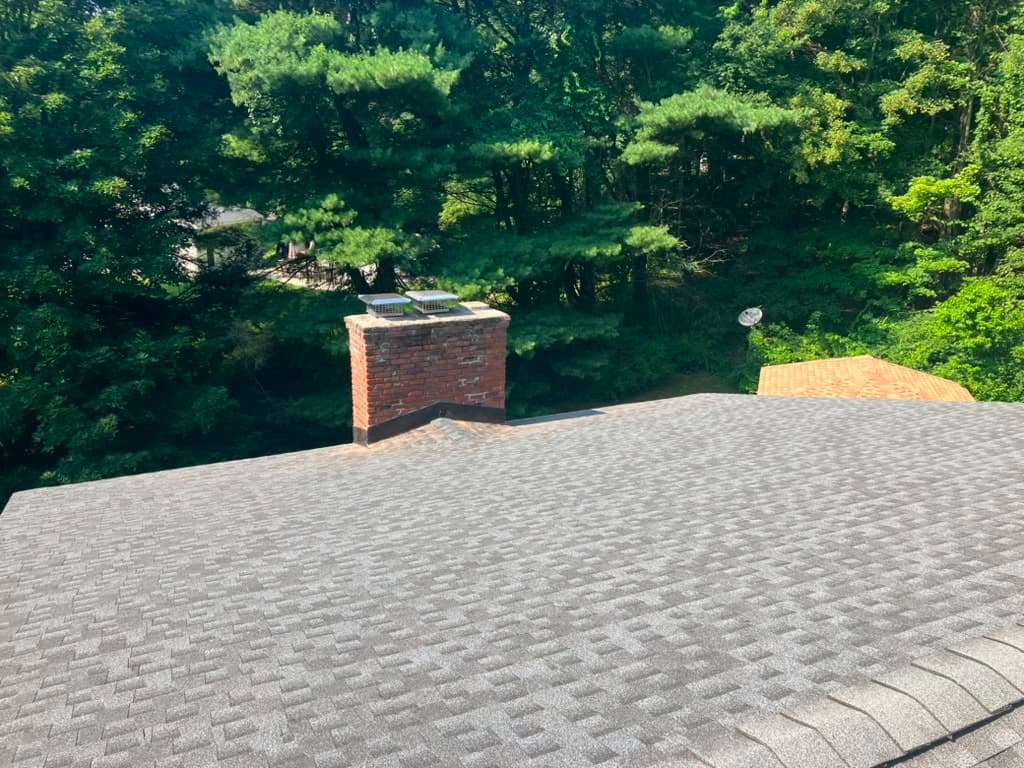
Ridge caps are the third weak point. They take direct wind loading at the highest point of the roof, and a ridge cap that’s hand-nailed instead of properly fastened and sealed is often the first thing to go in a Nor’easter.
Signs your roof wasn’t built for this terrain
A few things worth checking after any storm with sustained wind, especially if your home sits on a ridge, at the top of a hill, or in a clearing facing the river:
- Shingle tabs that look lifted or slightly curled at the corners, even if they haven’t blown off
- Exposed or backed-out nail heads along the edges
- Granules collecting in the gutters after wind events, not just after rain
- A ridge cap that looks uneven or has visible gaps at the seams
- Soffit or fascia trim that’s come loose, which usually means wind got up under the roof edge at some point
None of these mean the whole roof needs to come off. Often it means the edge detailing and ridge fastening need to be redone even if the field of the roof is fine.
What a wind-appropriate install actually looks like
For homes in exposed parts of Putnam and northern Westchester, we build a few things into the install regardless of which shingle line the homeowner picks. Six-nail fastening in the field, not four. A full starter strip at both the eaves and the rakes, not just the eaves. Ridge vent and ridge cap mechanically fastened and hand-sealed at the seams rather than relying on the factory strip alone to hold in gusting wind. And on the most exposed sites, we’ll talk through whether a standing-seam metal roof makes more sense than shingle altogether, since metal handles sustained uplift differently and doesn’t rely on an adhesive bond the way shingle does.
None of this changes the sticker price of the shingle itself. It changes how it’s put on, and on a hillside above the Hudson, that’s usually the difference between a roof that loses a few tabs in a bad storm and one that comes apart at the edge.
If you’re not sure whether your current roof was built with the local wind exposure in mind, we’ll climb up and take a look. Most of what determines whether a roof survives the next Nor’easter is visible from the edge and the ridge, not hidden somewhere in the field of the shingles.